The turning axle.
At the contact between an axle and a hub, lubrication helps movement happen with less friction.
THE SCIENCE BEHIND THE SERVICE
A working engine depends on something you can barely see.
Follow the oil. Look between the moving surfaces. Discover why a small maintenance task carries so much responsibility.
Look inside the oil film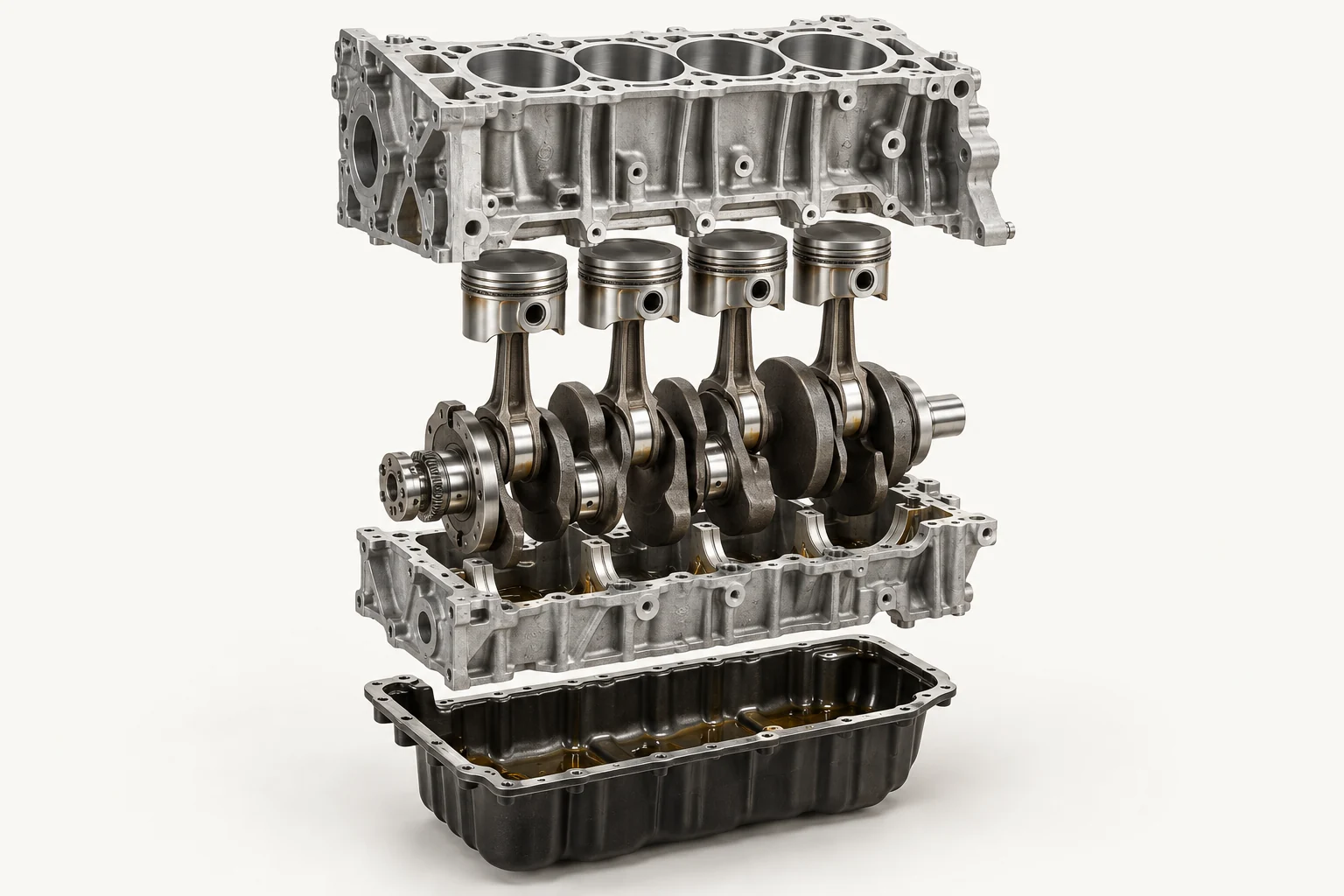
01 / A LASTING IDEA
A wheel turning on an axle. A shaft turning in a bearing. A piston moving inside an engine. Across different machines, moving contacts give us a reason to manage friction and wear.
At the contact between an axle and a hub, lubrication helps movement happen with less friction.
As machinery does repeated work, its lubricated contacts must carry load while controlling friction and wear.
Today’s engine oil is formulated for demanding conditions and specific requirements. The underlying purpose is still practical.
Illustrative objects showing a shared mechanical principle across different kinds of machinery.
02 / FOLLOW THE OIL
Swipe across the diagram, or choose a stop below.
Simplified flow diagram. Engine layouts vary; relief and bypass paths, coolers and individual branches are omitted.
01 / THE SUMP
In a wet-sump engine, oil collects in a reservoir below the engine. The pickup draws from this supply so the pump can circulate it again.
Oil level and oil condition answer different questions. A full sump does not tell you how much service life remains.
03 / CHANGE THE SCALE
Metal surfaces have microscopic roughness. What happens between those surfaces helps explain why lubrication matters.
Fluid separation
Under suitable conditions, a fluid film can carry load and separate moving surfaces. The oil still resists motion, but direct contact between surface peaks is reduced.
A simplified view of full-film lubrication.Oil is more than a physical film. Its formulation also helps manage wear, deposits and other demands inside the engine.
04 / WHY IT NEEDS CARE
Oil keeps circulating, but its condition can change. Heat, contamination and changes in its additives are part of the reason it has a service life.
Exposure to heat and oxygen can change oil and contribute to deposits. Engine operation affects the conditions the oil experiences.
Fuel, moisture and particles can enter the oil. Their effects and the maintenance response depend on the engine and how it is used.
Additives support jobs such as wear protection, cleanliness and oxidation resistance. Their effectiveness does not stay unchanged forever.
Colour alone cannot tell you when oil needs changing. A service decision needs the vehicle’s requirements and operating information; an oil analysis can answer additional questions when appropriate.
THE RIGHT OIL. THE RIGHT MOMENT.
A high-use vehicle can reach a mileage limit quickly. A vehicle with short trips, long periods of idling or lower use presents a different picture.
Kilometres matter. So do operating conditions, load and engine hours where the manufacturer uses them.
Follow the applicable time limit even if the vehicle has not reached its mileage limit.
Use the required oil specification, relevant maintenance schedule and oil-life monitor instructions where fitted.
There is no single oil-change interval or oil grade for every fleet vehicle.
BRING IT BACK TO YOUR FLEET
The Ready Fleet program brings those details into a vehicle-specific plan. Suitable work can share a visit while each vehicle keeps its own service requirements.
See how we plan fleet maintenanceThis chapter uses representative, enlarged illustrations to explain principles. It does not set a service interval or depict a particular vehicle’s internal layout.
Engine and historical-object illustrations created for this chapter. Functional diagrams are simplified and not to scale.